Search is changing, and most businesses are not ready for what that actually means.
At Google I/O on 19 May 2026, the company announced what it described as the biggest upgrade to its search box in over 25 years. The wording matters, so let me quote it directly from Google’s own announcement. Liz Reid, Google’s VP of Search, wrote that the search box is now “completely reimagined with AI.” She called it “the biggest upgrade to our Search box in over 25 years.”
And here in New Zealand, most businesses really are not ready. A 2024 NZIER and Spark survey found that 68% of New Zealand SMEs have no plans to evaluate or invest in AI technology. For comparison, only 38% of Australian SMEs said the same, so our uptake is lagging. That gap matters, because the businesses paying attention now are the ones who will be visible when their customers go looking.
I want to be careful and accurate here, because there is a lot of loose talk online about Google “removing the search bar.” That is not quite what is happening, and the difference is important if you are making decisions about your own website. So let me explain what Google has actually said, and then what it means for you.
What Google actually announced
Google has not deleted the search box. It has rebuilt it. In Google’s words, the new “intelligent Search box” is designed to “anticipate your intent” and “helps you formulate your question with AI-powered suggestions that go beyond autocomplete.” It expands as you type, so it can hold longer, more conversational questions, and you can now search using text, images, files, videos, or even open Chrome tabs.
Crucially, Google also said this, again in its own words: “You’ll continue to get a range of results from Search, just like you do today.” So the blue links have not vanished. What has changed is what sits in front of them, and how often people feel they need to click through at all.
That is the real shift. Search is moving away from a simple list of ten links, and towards AI-generated answers that sit directly inside the results page. For a lot of businesses, that is going to feel like a loss of traffic. In some cases it already is.
AI search is already changing how New Zealanders shop
This is not just a United States story, and that is the part I most want New Zealand business owners to hear. A 2025 survey of consumers across the US, UK and Australia and New Zealand found that 33% of Gen Z and 26% of Millennials now prefer AI platforms over search engines for researching products, a trend the report noted was particularly pronounced in Australia and New Zealand. In fact, 46% of Gen Z and Millennials in Australia and New Zealand said they use AI tools like ChatGPT and Perplexity every day. Across the survey, Gen Z are now nearly as likely to use AI platforms (33%) as search engines (37%) when researching what to buy. Your future customers are already asking AI first.
Here are the figures in one place, so you can see the shift at a glance.
| What the data shows | The number | Source |
|---|---|---|
| Clicks to a website when an AI summary appears | 8% (versus 15% with no AI summary) | Pew Research Center, July 2025 |
| Clicks on a link inside the AI summary itself | 1% | Pew Research Center, July 2025 |
| Predicted fall in traditional search volume by 2026 | About 25% | Gartner, February 2024 |
| NZ SMEs with no plans to evaluate or invest in AI | 68% (Australia: 38%) | NZIER and Spark, 2024, via MBIE |
| Gen Z and Millennials who now prefer AI over search engines for product research | 33% Gen Z, 26% Millennials | Commerce and Future Commerce, 2025 |
| Gen Z and Millennials in Australia and New Zealand using AI tools every day | 46% | Commerce and Future Commerce, 2025 |
| Gen Z using AI platforms versus search engines for product research | 33% AI, 37% search engines | Commerce and Future Commerce, 2025 |
I am not sharing those numbers to alarm you. I am a business owner too, and I know that “your traffic is going to fall” is not a helpful thing to hear without a plan attached. So let me give you the other half of the story, because there genuinely is one.
How to get found in AI search
The brands that win in this next phase are the ones that can answer those questions clearly and consistently, everywhere a decision gets made. Not just on the website, but across every touchpoint where someone is weighing you up.
This is no longer just SEO. This is about becoming the obvious answer in your category. We call it AI search visibility, and it is exactly what we have been building at Net Branding.
From being searchable to being chosen
There is a useful way to think about the difference.
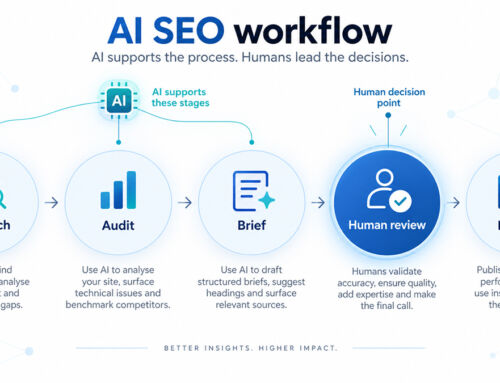
Old search rewarded you for being findable. You optimised a page, you ranked, you waited for the click. New search rewards you for being citable and trustworthy. The AI reads the web, decides who actually knows their subject, and surfaces that source as the answer. AI builds on top of good SEO, by the way, not instead of it. The strong foundations still matter. They are just no longer the whole job.
So the work shifts. It becomes about demonstrating real expertise in plain language. About answering the genuine questions your customers ask, in full, in your own voice. About being consistent across your site, your profiles, your reviews, and everywhere else AI looks when it decides who to trust.
While everyone else is still trying to chase rankings, the real opportunity is to become the source that both AI and customers naturally turn to. That is the move from being searchable to being chosen, and the businesses that understand it early are the ones that will lead the next wave of search.
Where to start
If you are reading this and wondering whether your business is ready for AI-led search, that is the right question to be asking, and it is a good time to be asking it rather than a year from now.
If you would like to talk it through, we would be glad to have a no-obligation chat about where your business sits today and what the next sensible step looks like. No hard sell. Just a useful conversation with people who have been doing this in New Zealand since 2008.
That’s Cathy from Net Branding.
Be Seen, Be Heard, Be Found, Trusted and Cited Online.™
Common questions we are hearing
Is Google removing the search bar?
No. Google has reimagined the search box, not removed it. The AI answer now sits in front of the results, but Google has said you will still get a range of normal results just as you do today. The change is in how often people feel they need to click through, not in whether the links exist.
Will I lose website traffic because of this?
For some queries, yes, and some businesses are already feeling it. When an AI summary answers the question on the page, fewer people click through. The honest answer is that traffic for purely informational searches is likely to fall. The work now is to make sure you are the source the AI quotes, and to focus on the searches where people are actually looking for a business like yours, not just a quick fact.
Where do the AI engines actually pull their answers from?
From more than just your website. AI systems treat agreement across several independent sources as a signal that you can be trusted, so they look at your own pages, but also at reviews, respected directories, YouTube, and genuine discussion on places like Reddit. Being mentioned consistently in the places AI already trusts matters as much as your own site.
Does traditional SEO still matter, or is it dead?
It still matters. For Google’s AI answers in particular, the pages it cites tend to be ones already ranking well in normal search. So strong SEO is now the foundation the AI builds on, not something it replaces. AI builds on top of SEO, not instead of it.
Does keyword-stuffing still work?
No, and it can now actively hurt you. Research into AI-generated answers found that pages written for algorithms rather than people performed worse. AI is looking for clear, genuine expertise written in plain language, not pages crammed with keywords.
What is the difference between AEO and GEO?
They are close cousins. AEO, answer engine optimisation, is about being the direct answer that gets pulled into features like Google’s AI Overviews and snippets. GEO, generative engine optimisation, is about earning a mention or citation inside the answers that tools like ChatGPT and Perplexity generate. Most of the work that serves one serves the other, so you do not have to choose between them.
How do I check whether my business is even visible in AI yet?
Start by asking the AI tools the questions your customers would ask. Open ChatGPT, Google AI Mode and Perplexity, ask about your category and your competitors, and see whether your business comes up, how you are described, and who shows up instead of you. That gives you an honest picture of where you stand, and it is the starting point for any AI search visibility work. If you would like a hand reading the results, that is exactly the kind of thing we can look at together.