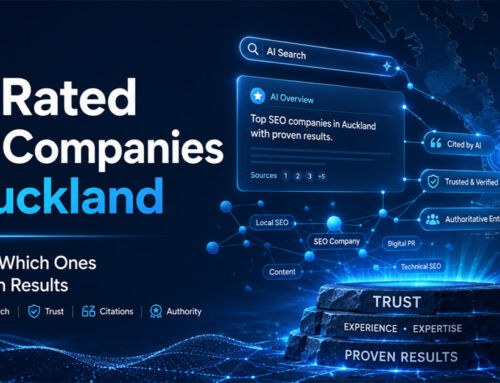
You have probably just done the same thing twice. Searched, opened five or six tabs, read the first three, and closed them again without learning anything that would help you choose.
Perhaps there was a meeting before that. Somebody confident, a slide deck with percentages on it, a lot of talk about being data driven. You came out of it unsure whether you had just met a good operator or a good salesperson, and with no reliable way of telling the difference.
That is why the phrase you typed has two conditions built into it. Top rated, and proven results.
So the question worth asking is not which Auckland SEO company claims to be the best. It is which one can prove what it has done.
Those are very different questions, and only one of them can be answered in a meeting.
This article is not a list of Auckland SEO companies. It is the method for working out which ones deserve a place on your shortlist, including whether we do. Take it into your next three meetings and use it on all of us.
Why every Auckland SEO company looks the same on paper
Open four agency websites in a row and something odd happens. They start to blur.
Data driven. Results focused. Transparent reporting. No lock in contracts. Proven results. The same five phrases, in a slightly different order, over a slightly different photograph.
You might assume that is a failure of your own reading, or that the real difference is technical and simply beyond you. It is neither. The sameness is structural. When every provider in a market claims the same things, and none of them is required to prove any of it, the claims stop carrying information. They become the cost of entry rather than a way to tell anyone apart.
So how do you compare businesses that have made themselves impossible to compare?
You stop reading the claims and look at what sits underneath them.
Directory listings and badges
The “top ten agencies” pages that dominate this search are published by directories. They are useful for discovering that a company exists. They are close to useless as a quality signal.
The ordering usually reflects review volume collected on that platform, how complete the agency’s profile is, and in several cases whether the agency pays for a listing tier. None of it measures whether a single client got a result. Read one of these pages carefully and you will notice the criteria are either absent or described in a sentence near the bottom.
That does not make them dishonest. It makes them a different thing from what the heading promises.
Google reviews and the map pack
Star ratings are more meaningful, because the people leaving them are usually real clients. They still need reading properly.
A five star average across six reviews tells you less than a 4.6 across ninety. Recency matters more than the average, because agencies change hands and lose the people who did the good work.
The ordering of the map results is worth understanding too, because it is not a ranking of quality. Google weighs three things there. How relevant the listing is to what was typed, how far away it is from wherever the person searching happens to be standing, and how prominent the business is, which is where reviews and general visibility come in. Distance carries a lot of that weight, which is why the “top rated” companies you are shown will change as you move across Auckland. Run the same search from Albany and from Manukau and compare the two lists. If you have ever wondered why a competitor seems to be everywhere and you are not, that is often the first place to look.
An agency that ranks itself well locally has at least demonstrated it can do local SEO. That is worth something. It is not the same as proof that it grew somebody’s revenue.
So a directory page or a map listing gets a company noticed. Whether the right buyer then finds them, and whether what that buyer hears is accurate, are separate questions with separate answers, and none of these ratings touches either one.
Full service digital agencies
SEO is one of several things they do, alongside paid advertising, social and web development.
The advantage is that the channels talk to each other, which matters more than it sounds. Your paid search data tells you which terms convert, and that should shape what gets optimised for organically. Split those across two suppliers and nobody joins them up.
The risk is that SEO becomes the quiet part of the account while the noisy part gets the attention. Ask how many hours a month go to it and who does them.
Independent consultants and contractors
Rarely in the tidy lists, and a large part of the real Auckland market. An experienced individual, often a former agency lead, working with you directly.
You get seniority without the overhead and a closer relationship than most agencies will give you. What you do not get is depth. When one person holds everything, holidays, illness and a busy month all become your problem too.
The one that does not appear in the list
There is a fifth arrangement, and it hides inside the other four. Some New Zealand agencies sell the work and send it offshore to a white label supplier, then pass the reports back with their own logo on them.
It is not automatically bad, and some of those suppliers are competent. What it does mean is that the person who understood your business in the meeting is not the person doing the work, nobody in the delivery chain has ever seen your market, and when something goes wrong there is a time zone and a subcontract between you and an answer.
You will not find this on anybody’s website. Ask directly. Who does the work, are they employed here, and can I meet them.
Set and forget, and what it really costs
A platform keeps producing whatever it was configured to produce, whether or not that is still the right thing. The results become whatever the tool decides they are. Fine when somebody experienced reviews the output each week and steers it. Without that person you are not buying capability, you are buying volume, and paying monthly for it.
What “proven results” should mean
There is a fifth arrangement, and it hides inside the other four. Some New Zealand agencies sell the work and send it offshore to a white label supplier, then pass the reports back with their own logo on them.
It is not automatically bad, and some of those suppliers are competent. What it does mean is that the person who understood your business in the meeting is not the person doing the work, nobody in the delivery chain has ever seen your market, and when something goes wrong there is a time zone and a subcontract between you and an answer.
You will not find this on anybody’s website. Ask directly. Who does the work, are they employed here, and can I meet them.

Now the second half of your search, and the part that should decide it. This is where claiming to be the best and proving what you have done come apart, because everybody does the first and very few will show you anything that survives a question.
The good news is that you do not need to be technical to test a results claim, because the test is about completeness rather than expertise. A real proof point tells you four things, and a claim missing any one of them is not proof, however impressive the number attached to it.
Where the numbers started. A percentage with no starting figure is not evidence. Traffic up three hundred percent from eleven visits a month is a true statement and a meaningless one.
What period is being compared to what. Matched date ranges, not a strong month held up against a weak one. Seasonality is regularly sold as performance, usually without anybody intending to deceive.
What was left out of the count. Branded search is the common one. If somebody’s brand searches are counted inside their organic growth figure, you are being shown the result of their radio advertising.
And what else was happening at the same time. A site migration, a new offer, a price change, a competitor closing. If the only explanation on offer is the agency’s own work, the analysis is not finished.
There is a legal dimension here too. Under the Fair Trading Act 1986, which the Commerce Commission enforces, a business has to hold reasonable grounds for a claim at the time it makes the claim, rather than assemble the evidence later if somebody asks. That applies to us as much as anyone. It gives you a fair question to put to any agency, including this one. Could you produce that file today?
If the answer arrives slowly, or arrives as another percentage, you have learned what you needed to know.
That is the whole of being trusted, and there is nothing mysterious in it. Trust is not a tone of voice or a set of badges in a footer. It is whether the thing you were told can be checked.
Questions to take into the meeting
Use these on every agency you speak to. They work on us.
- Can you show me a result with the starting number, the date range, and what was excluded from the count?
- What else was happening in that client’s business at the same time?
- Which parts of your process use AI, and which parts are a person deciding? Say it in plain words.
- How do you check whether my business is described correctly in AI answers, and how often?
- Who actually does the work, and will I meet them?
- Tell me about a piece of work that did not go the way you expected. What did you do?
- If we stopped after a year, what would I still own?
Then listen to how the answers land, not just what they contain. Specific and slightly uncomfortable usually means true. Smooth and general usually means rehearsed. You will hear the difference immediately, and you do not need to be technical to hear it.

The part most Auckland agencies are not measuring yet
So this is what a reading looks like when somebody takes one. It is the one part of this article where I would ask you to slow down.
When somebody asks an AI system for a recommendation, the answer is assembled from sources, and the sources are not neutral. In one New Zealand category, across a tracking window of three weeks, we collected 1,953 citations from AI answers. Thirty eight percent came from corporate websites. Seventeen percent came from user generated content, which mostly means forums. Fourteen percent came from editorial sources and thirteen percent from institutional ones. Read that second figure again. Close to a fifth of everything those systems drew on was written by members of the public rather than by any business in the category.
Here are two of ours, with the clients anonymous.
Reading one: showing up more than once
What the measurement showed:
- A client in a crowded, competitive category, with multiple mentions in AI answers.
- Each mention tracked separately, with its own visibility figure, its own sentiment score and its own average position.
- Those mentions appearing above several established competitors in the same category.
In a field where a great many businesses are not being named at all, that is a good place to be.
The mentions also read slightly differently in tone from each other, which is worth knowing in itself. The systems form their impression separately each time, so being seen and being heard are not one event. You can appear often and still be described in a way you would not have chosen.
Reading two: becoming the source
What the measurement showed:
- A directory style site, covering many businesses across one area, tracked over its whole category.
- Its own pages were the single most referenced source in that category.
- It was referenced ahead of both the city site and the national tourism site.
Structure and topical authority did that. A site organised properly across an entire subject area can become the thing these systems reach for, ahead of far larger and better known names.
That is worth watching, because directory style spaces are among the most likely to be absorbed by AI answers. When the answer arrives already assembled, the question stops being where you rank in a list and becomes whether you are what the list was made from.
Now, applying our own standard from the section above. Those are diagnostic readings taken over a few weeks. They show what we can see and diagnose. They are not before and after results, and we will not present them as though they were until we have the second reading.
Red flags, and where the cost of choosing badly lands
The risk of a poor choice is rarely the monthly fee. It is the year you spend before you are certain, and what you cannot take with you when you leave.
Watch for a long minimum term with vague exit conditions. Watch for accounts, domains, tracking or content that sit in the agency’s name rather than yours. Watch for reporting that never reaches enquiries or bookings, however handsome the charts. Watch for a guaranteed position by a specific date, which nobody can honestly promise. And watch for what happens when you ask about work that went badly, because a flat refusal to discuss it tells you how the difficult months will go.
One of these on its own is usually manageable. Three together is a pattern.
Where Net Branding sits, and when we are not the right fit

We are a full service agency, based in Remuera, working with businesses across Auckland, New Zealand and further afield. The work is done here, by people you will meet.
I have been doing this since 2008, when the competition was directory salesmen rather than AI specialists. I sat across the table from plenty of those, promising owners a listing that would change everything, and I watched a good number of them pay for years and get very little back.
Three shifts have arrived since. Directories, social, and AI. The tools change completely each time and the question underneath never does, which is whether a buyer can find you and whether they trust you when they do. The sales patterns repeat too, which is why this year’s confident AI pitch sounds so familiar.
There is a pattern in that, and it is older than AI. For a while everybody was a website designer. Then everybody was an SEO specialist. Then everybody did social. Now everybody is an AI expert, and in each wave the label has arrived a good deal faster than the knowledge behind it. Words get attached to services because they are selling, not because anything underneath has changed.
Our position is that AI visibility builds on good search foundations rather than replacing them. You will hear the opposite from people selling AI as a fresh start.
We deal with all of it the only way I know how, which is to test things before recommending them. We run several websites of our own for exactly that purpose, infrastructure we can break without a client paying for the lesson. When something new appears it goes on one of those first, and the test tells us three things. Whether it is doable at all, whether it is worth doing, and what it costs to keep running once the novelty wears off.
That has become more valuable as the pace has picked up, not less. The interesting comparison is rarely whether a thing works. It is what happens when the same job is done automatically against the same job done with a person involved at the right point, and the gap between those two outcomes is usually much wider than anybody selling the automated version will tell you.
I am not going to tell you that the advice circulating in this market is wrong, because that is a claim I would then have to substantiate case by case, and the section on proof above argues against exactly that kind of statement. What I will say is that some of it we have tested and found it did not hold. The automation experiment earlier is one of those. That is the whole point of testing. It is the difference between having an opinion about AI and having a finding.
We also publish our AI policy, setting out where AI is used in client work and what level of human review sits behind each service. Ask any agency for the same thing, including us.
One more thing decides more about the next twelve months than anything on a pricing page. When you sit down with most agencies, the person across the table is not the person who will do the work. They are there to win the account, and the team arrives once the contract is signed. Ask early, because the gap between the person who sold it and the people who deliver it is where most disappointment lives.
At Net Branding, whoever is in front of you has the team behind them, and what you are told in that meeting is what the team has said. That has a practical consequence you should expect from us. If something cannot be done, we will tell you it cannot be done. If it can be done, we will tell you how. There is no sugar coating in either direction.
I have been described as direct more than once, and it is a fair description. I have never seen much value in holding back what is plainly in front of me. A client who gets the comfortable version of a situation only finds out the real one later, usually at a worse moment and with fewer options. Say it as it is, and then you can either work from there or celebrate it. Both of those beat being managed.
What our clients say
I would rather you did not take my word for any of that, so here is the summary of our first one hundred reviews. Read it the way this article has asked you to read everything else. Check the volume, check the dates, and go and look at the individual reviews yourself rather than accepting a summary of them, including this one.
Common questions
How much does SEO cost in Auckland?
There is no single right number, and anyone quoting one before understanding your situation is guessing. The more useful question is whether you can sustain the level you choose for at least six months, because stopping at month four is how most budgets get wasted. Work backwards from your margins rather than picking a figure.
Whatever the figure, you should be able to see what it buys. Ask for the split between strategy, production and reporting, and ask what happens to the fee if the scope drops. An agency that cannot break its own invoice down is unlikely to be able to break your results down either.
How long before I see something?
Tracking and reporting improvements should show within weeks, because those are repairs rather than growth. Movement in rankings and enquiries usually takes three to six months depending on your starting point. Visibility in AI answers moves more slowly again.
Does AI search replace SEO?
No. AI systems build answers from sources they can crawl, parse and trust, which are the same foundations good SEO has always rested on. What changes is that being crawled is no longer the same as being credited.
What should I own if we part ways?
Your domain, your website and its content, your Google Analytics, Search Console, Google Ads and Business Profile accounts, and your tracking configuration. Agree it in writing at the start, when it is still an easy conversation.
How do I check whether a case study is real?
Apply the four tests above, then ask whether the client would take a short call. You will not always get one, and how the request is handled tells you nearly as much as the answer would.
If you would like to talk it through
If you take one thing from all of this, take the five questions underneath it. Are you seen. Is what people hear about you accurate. Can the buyer who needs you find you. Can anything you claim be checked by somebody who does not know you. And when a machine answers a question in your field, does it name you.
Every one of those can be measured. An agency that can only answer three of them is not doing worse work than it used to. It is doing the same work in a market that now asks for five.
And if even that is more than you want to carry into a meeting, carry one sentence instead. Do not ask who says they are the best. Ask who can prove what they have done.
If you are somewhere between curious and sceptical, that is a sensible place to be, and it is where most of the people we speak to start.
A reasonable first step is knowing where you stand. We can measure how your business currently appears in AI answers and show you what is there rather than what anybody assumes is there. No commitment attached to that, and if the answer is that you are already in good shape, we will tell you so.
Bring your questions, your doubts, and the last report somebody sent you. We will look at it together and work out whether any of this is worth acting on for you.
Written by Cathy Mellett, Founder and Managing Director of Net Branding Limited, working in New Zealand’s digital and search space since 2008.
Be Seen, Be Heard, Be Found, Trusted and Cited Online.™