You have been shown the website. It looks good, the price is attractive and AI has built most of it. So what exactly should you be checking before you say yes?
I have no issue with AI helping to build websites. We use AI ourselves at Net Branding, and I think it can be a very useful part of the development process. What I am far more interested in is who understands the website after the AI has finished generating it.
That question becomes even more relevant when we look at the AI built websites that have come across our desk. They have not necessarily failed. Traffic did not suddenly disappear and the websites did not collapse. In fact, the result was far less dramatic than that. Traffic largely stayed where it was.
Most business owners are not replacing a website simply to own a newer website. There is usually an expectation sitting behind the spend. You want more enquiries, better visibility, stronger positioning, more business, or perhaps all of those things.
So before you decide whether an AI built website is cheaper, I think you need to look beyond the build itself. What happens after launch?
You Have Seen the Website. But What Are You Actually Buying?
The current sales proposition is quite compelling. AI can create your website quickly and, in some cases, you can see the finished design before deciding whether you want to pay for it at all. If you are comparing that with a conventional website project involving planning, design, development, testing and ongoing conversations with an agency, I can understand why the AI option gets attention.
There is nothing wrong with asking why a website should still cost thousands of dollars if software can produce something attractive in a fraction of the time. I think that is a fair question.
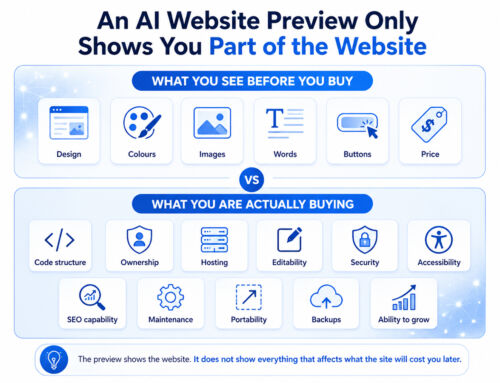
The problem is that the preview shows you the easiest part to judge. You can see the design, read the words, click the buttons and decide whether you like the photographs. What you cannot easily see is:
- How the website has been structured underneath.
- Who controls the code and hosting.
- Whether another developer could take it over.
- How easy it will be to change.
- Whether accessibility has been properly considered.
- Whether the site gives you enough room to keep building your SEO and AI search visibility.
Those things tend to become much more important later.
What Happens When Somebody Else Has to Work on It?
This is where our tech team has run into a different issue. We can often see what the original builder was trying to achieve, but then we have to work backwards to understand exactly how it was put together.
Our tech team describes it as having to unwind the website. Sometimes there is very little development history to follow. You cannot easily see what was changed, when it was changed or why a particular approach was chosen.
That is our own experience. I do not want to dress it up as something an academic paper somehow proves.
There is research that supports the wider concern around maintaining AI generated code. A 2026 study published in the Journal of Systems and Software reviewed 109 papers, ran two industry workshops with software practitioners and tested AI generated patches on real software problems using three different models. The researchers found that most existing research has concentrated on whether generated code works, while the practitioners themselves put maintainability and readability first, and warned that generated code can speed up the build up of technical debt. [1]
The website works today. Could somebody else understand it next year?
When the Fix Starts Costing More Than the Build
This is where a very cheap website can stop feeling quite so cheap. You might ask for what appears to be a simple change. Add a service. Change part of the homepage. Create another location page. Move something in the navigation.
Before the new developer can make that change, they may first need to understand:
- Where that section is controlled.
- What else is connected to it.
- Why it was built that way.
- What could break if they change it.
You can end up paying somebody to answer those questions before they have even started the job you called them about. We have reached situations where repairing and reworking what is there becomes less commercially sensible than rebuilding it properly.
I would not suggest that happens with every AI built website. It does not. But it happens often enough for me to think the question belongs in the buying decision. What does the website cost to build, and what is it going to be like to own?

Diagram 2: The cost that does not appear in the website quote.
Small SEO Jobs Start Becoming Development Jobs
SEO is rarely one enormous piece of work. A lot of progress comes from small changes made consistently over time. You may want to:
- Expand a page that has started to rank.
- Add a useful internal link.
- Improve the title of a page.
- Answer another customer question.
- Create a page for a new service.
- Update an old article.
- Improve a heading.
- Add structured information.
- Fix a redirect.
None of those jobs sounds particularly large. If each one needs to be scoped, quoted, coded and deployed, businesses naturally make fewer changes. And eventually, they stop asking.
The site still works. Nothing obviously breaks. It just freezes. A year later, the business has changed but the website has not.
Basic SEO Is Not the Same as Building Authority

Diagram 3: From basic SEO to AI search authority.
An AI built website can have perfectly good basic SEO. I think we should be very clear about that. It may have:
- Sensible page titles.
- Meta descriptions.
- Good heading structures.
- Image descriptions.
- A sitemap.
- Structured data.
- Mobile friendly pages.
- Pages that Google can crawl and index.
Good. Those things matter. But that is still the starting point.
The deeper work begins when you start asking why Google, or an AI search system, should consider your business a useful source on a particular subject.
Google addressed this directly on 15 May 2026, when it published new guidance about visibility within its generative AI search features. Google was very clear on one point. SEO is still relevant. Its AI search features continue to draw on Google’s existing search index, ranking systems and quality systems. Google recommends a clear technical structure alongside useful, unique content that offers real knowledge and experience. [2]
That is where I think deeper SEO starts.
There is one technical delivery check to make here too. Google can render JavaScript, but that does not mean every AI crawler behaves the same way. MERJ and Vercel crawler testing published in December 2024 found that the major AI crawlers they measured did not execute client side JavaScript. [7] So if important content only appears after JavaScript runs, ask whether that content is also available in the initial page response. You do not need to choose the rendering method yourself. You do need to know that the information you want found is actually available to the systems trying to read it.
What Does Deeper SEO Actually Look Like?
Deeper SEO is not about creating hundreds of pages simply because you can. In fact, that can take you in completely the wrong direction. It is about properly developing the subjects that sit around what your business does.
Take a plumbing company. A page saying you offer drainage services is useful, but customers have questions beyond the word drainage. They may want to know:
- Why the same drain keeps blocking.
- When CCTV inspection makes sense.
- What the signs of a damaged underground pipe are.
- Whether tree roots could be involved.
- Whether drainage issues differ between older and newer properties.
Now the website starts demonstrating knowledge around the service instead of simply stating that the service exists. The same applies in almost every industry.
Your services connect to real customer questions. Those questions connect to examples, experience, locations, people and supporting knowledge. Internal links connect related information. Reviews and mentions outside your website add another layer. Other sites may refer to your business. Named people become associated with particular expertise.
That starts to create a much clearer picture of who you are and what you actually know.
Google Is Asking for More Than Generic Content Too
Google’s 2026 guidance for generative AI search specifically talks about creating valuable, non commodity content.
Google says content based on your own knowledge, experience and point of view is more useful than simply repeating information that already exists elsewhere. It also cautions against creating large volumes of pages simply to target variations of search questions. [2]
That fits very closely with what we see in practice. Generic copy is easy to generate now. Expertise is not.
If the wording on your website could be placed on ten competing websites without anybody noticing, what have you actually given a search engine to distinguish? Your experience should be visible. Your knowledge should be visible. The way you solve problems should be visible. That is much harder to create with one prompt.
Related reading: Human centred AI content for AI Overviews looks more closely at how first hand experience, clear entities and useful answers support AI search visibility.
A Website Cannot Build Authority If It Stops Growing
This may be the quieter cost of a website that is difficult to edit. Nothing dramatic happens. You simply stop adding things.
A useful question comes up and nobody publishes the answer. A service changes and the page stays the same. A page starts appearing in search, but nobody develops it further. An internal link would help someone move between two useful pieces of information, but it becomes another developer request.
Meanwhile, another business keeps building. They answer more questions, add examples, update older material and develop supporting pages around the services they want to be known for.
After two years, the difference between the two websites is no longer simply how they were originally built. One has accumulated knowledge. The other still looks much the same as it did on launch day.
This is why I put editability so high on the list of things a business owner should ask about. Can your website keep showing what your business knows? If it cannot, that becomes more than a website management problem. It can become an SEO and AI visibility problem too.
The Website Can Look Beautiful and Still Be Wrong Underneath
This is a difficult part for a business owner because design is easy to see. Technical quality is not.
You can decide whether the site looks modern, whether you like the colours and whether the words sound right. What you probably cannot tell from looking at the homepage is whether the website has accessibility problems, unnecessary software dependencies or issues another developer may struggle with later.
That is not unique to AI. Human developers can build poor websites too. So once again, I come back to the same question. Who checked it?
Accessibility Cannot Be Judged From the Preview
Accessibility is another area where the finished website can look fine to one person and be difficult for somebody else to use. You may navigate with a mouse. Another visitor may use a keyboard. Someone else may rely on a screen reader.
Heading structure, form labels, navigation order, image descriptions and other details suddenly matter in a very different way.
There is research directly related to AI website builders here. Researchers Zsuzsanna Palmer and Sushil Oswal created business websites using three generative AI website builders and tested the finished sites using both accessibility tools and a screen reader. None of the three websites they tested was fully accessible to screen reader users. The researchers identified issues around layout, navigation, headings and other accessibility elements. [4]
It is a study of three tools. We should not turn that into a claim about every AI built website. But accessibility needs to be tested. A nice looking preview does not tell you whether the work has been done.
Performance Matters After Launch Too
Websites can become slow or awkward for plenty of reasons. Large images, too much JavaScript, unnecessary scripts, animation, third party software and poor mobile behaviour can all create problems. None of those issues was invented by AI.
The question is whether somebody checks for them. At the approval stage, you are naturally focused on the design. Does the homepage look right? Do you like the photograph? Does the new website feel better than the old one?
Six months later, your questions may be quite different. Why is the mobile version difficult to use? Why is this page slow? Why are people leaving? Why are we not getting the enquiries we expected? A website has to do more than photograph well in a sales presentation.
What Went Into the AI Tool?
There is another part of an AI website build that the finished site will never show you. The prompts.
What information was entered while the site was being created? Perhaps nothing sensitive at all. But a website project can involve customer information, internal plans, staff details, pricing information and material that has not been published yet.
The New Zealand Office of the Privacy Commissioner advises organisations using generative AI to consider carefully what personal or confidential information is entered into these systems and how that information may be retained or disclosed. [5]
If personal information is disclosed to an organisation outside New Zealand, Information Privacy Principle 12 may also need to be considered, depending on the circumstances and how the overseas provider is handling that information. [6]
You do not need to become a privacy lawyer to commission a website. It is reasonable to ask the person building it what tools they are using and what information is being supplied to those tools.
What Were You Told You Were Buying?
There is a commercial trust question sitting alongside ownership. Was the site sold to you as bespoke development? Were you told AI was doing most of the build? Were promises made about rankings, performance or no ongoing costs? I do not think using AI is the issue. The issue is whether what you were told accurately describes what you are buying.
The Commerce Commission’s guidance is straightforward: a business must have reasonable grounds for a claim at the time the claim is made, and must be able to substantiate it. [8] So if somebody says the website is bespoke, ask what bespoke means in this case. If they say it will rank, ask what work and evidence sit behind that claim. If they say you own it, ask whether you can actually move it.
This is not about trying to catch a provider out. It is about getting clear on the commercial arrangement before the website becomes important to your business.
Seven Checks to Make Before You Pay for an AI Built Website
You do not need to become a developer before buying a website. But I would make a few practical checks.
- Ask whether all important page content can be properly accessed and indexed by search engines.
- Confirm that the website has not accidentally been blocked from search through a noindex setting or another technical restriction.
- If the website replaces an existing site, make sure important old URLs have been redirected to their new locations.
- Check that important pages have sensible titles, descriptions and headings.
- Test every important form on both a desktop computer and a real mobile phone.
- Have somebody technically competent look at the website underneath the design, particularly if the business handles personal information, payments or user accounts.
- Ask who maintains the website, when the backup was last successfully restored, and who is responsible for recovery if something goes wrong.\
One more question: Can you actually change it?
That question is surprisingly easy to forget when the website already looks finished.
So, Should You Buy an AI Built Website?
Possibly. I do not think the answer is automatically no.
If the website is technically reviewed, properly owned, easy to maintain, portable, accessible and gives your business room to keep developing its content and authority, then the fact that AI helped create it would not concern me very much. We use AI ourselves.
What would concern me is buying a website because the preview looks good and nobody being able to answer what happens afterwards. Who understands it? Who owns it? Who can change it? Who checks it? Who looks after it? And can the website continue developing as the business grows?
AI has made the production part of website development much faster. The website itself still has a job to do for years after the production stage is finished. That is the cost I would be looking at.
About the Author
Cathy Mellett is Director of Net Branding Limited. Net Branding has worked across websites, SEO, paid media and digital marketing since 2008. Today, that work also includes AI search visibility and helping businesses understand how traditional SEO, authority, trust and AI search fit together.
We use AI within our own work. We also believe that somebody competent still needs to understand, review and take responsibility for what AI produces.
Net Branding Limited
165 Orakei Road, Remuera, Auckland 1050
Phone: 09 523 0478
Email: sales@netbranding.co.nz
Website: www.netbranding.co.nz
Research and Source References
- Sun, X. et al. (2026). Quality assurance of LLM-generated code: addressing non-functional quality characteristics. Journal of Systems and Software. Literature review of 109 papers, two industry workshops and empirical testing of AI generated patches using three models. https://www.sciencedirect.com/science/article/pii/S0164121226001184 Journal version is behind a paywall. Free author preprint: https://arxiv.org/abs/2511.10271
- Google Search Central (15 May 2026). Optimizing your website for generative AI features on Google Search. https://developers.google.com/search/docs/fundamentals/ai-optimization-guide Announcement: https://developers.google.com/search/blog/2026/05/a-new-resource-for-optimizing Freely available, published under a Creative Commons Attribution 4.0 licence.
- Spracklen, J., Wijewickrama, R., Sakib, A.H.M.N., Maiti, A., Viswanath, B. and Jadliwala, M. (2025). We Have a Package for You! A Comprehensive Analysis of Package Hallucinations by Code Generating LLMs. 34th USENIX Security Symposium, Seattle, pages 3687 to 3706. https://www.usenix.org/conference/usenixsecurity25/presentation/spracklen Freely available.
- Palmer, Z.B. and Oswal, S.K. (2025). Constructing Websites with Generative AI Tools: The Accessibility of Their Workflows and Products for Users With Disabilities. Journal of Business and Technical Communication, volume 39, issue 1, pages 93 to 114. https://journals.sagepub.com/doi/10.1177/10506519241280644 Behind a paywall. Abstract freely available.
- Office of the Privacy Commissioner, New Zealand. Generative Artificial Intelligence. https://www.privacy.org.nz/resources-and-learning/a-z-topics/ai/generative-artificial-intelligence/ See also Artificial Intelligence and the Information Privacy Principles (21 September 2023). Freely available.
- Office of the Privacy Commissioner, New Zealand. Principle 12: Disclosure of personal information outside New Zealand. https://www.privacy.org.nz/privacy-principles/12/ Freely available.
- Vercel, with MERJ (17 December 2024). The rise of the AI crawler. https://vercel.com/blog/the-rise-of-the-ai-crawler Freely available. Note the date. This is server log analysis from December 2024, so crawler behaviour may have changed since.
- Commerce Commission New Zealand. Making accurate claims. https://www.comcom.govt.nz/business/dealing-with-typical-situations/making-accurate-claims/ Freely available.
All sources above were checked and the links verified on 31 August 2026. Two are behind academic paywalls, marked accordingly. The remaining six are freely accessible.
Internal source: Net Branding article working brief, Version 2, 31 August 2026. First hand traffic, maintainability and rebuild observations are identified as Net Branding observations within the article.