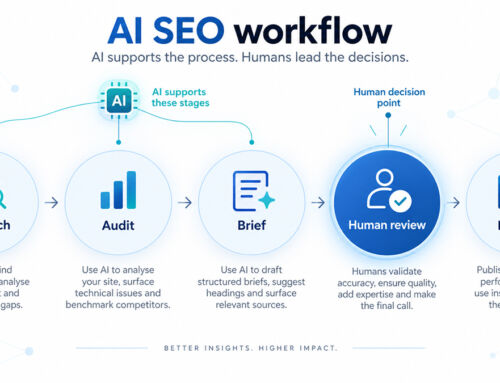
AI supports the process. Human judgement stays at the decision point.
A practical guide for business owners, marketing managers and in-house SEO teams.
AI SEO is the use of artificial intelligence to make SEO research, analysis, auditing and content planning faster without handing over the judgement that determines whether the finished work is actually useful.
That distinction is an important clarifier.
- AI can organise hundreds of keywords in seconds. It can identify patterns, review content and help build a detailed brief.
- It can also produce a perfectly readable article that says almost nothing.
For business owners and marketing teams, the challenge is not whether to use AI. It is how to use it without weakening the experience, authority and personality that already make your business credible.
This guide gives you a practical workflow for doing that across traditional Google Search, Google AI Overviews and AI search experiences such as ChatGPT.
What AI SEO Really Means and What It Does Not
AI SEO should be an efficiency layer.
It can support:
- Keyword and topic research.
- Search intent analysis.
- Keyword clustering.
- Content gap reviews.
- Technical SEO audits.
- Content briefs.
- Competitor research.
- Internal linking analysis.
- Editorial checks.
What it should not do is become the unquestioned author, strategist and editor.
AI can process information quickly. But, someone still needs to understand the business, the customer and why one SEO opportunity has more possible value than another.
At Net Branding, this distinction matters. We have worked across SEO, websites, digital advertising and content since 2008. More output has never automatically meant better SEO.
- Sometimes you need another article.
- Sometimes you need to improve the page you already have.
- Sometimes two competing pages need to become one.
And sometimes the right answer is not to create another page at all.
Why the Fear Around Low Quality AI Content Exists
AI makes publishing easy. Perhaps too easy.
A page can have correct spelling, tidy headings and a professional tone while adding almost nothing useful.
That is where low-quality AI content becomes a problem. The issue is not simply that AI helped create it. The issue is that nobody added anything the AI could not already generate for every other business.
Google’s more recent guidance on generative search encourages useful, unique, non-commodity content.
That brings us to a simple question.
Could your competitor use the same AI prompt and end up with almost the same page?
If yes, the content probably needs more work.
Try the Competitor Name Test
Take one of your existing pages.
- Remove your business name.
- Now insert the name of your closest competitor.
- Would almost everything else still make sense?
If it would, ask what your business actually contributed to the page.
A plumber can explain what a blocked drain is. So can AI.
The plumber may also know which symptoms usually appear before a recurring blockage, what customers often try before calling, and what they regularly find in Auckland homes.
That is harder to reproduce.
The same applies to a lawyer who knows what commonly holds up settlement, or a retailer who knows which question customers nearly always ask before buying.
Your experience does not have to sound dramatic.
It just needs to be real.
Step 1: AI-Assisted Research and Keyword Clustering
AI is very good at sorting information.
Imagine you have 400 keywords relating to plumbing.
You could ask:
Group these search terms according to likely user intent. Separate informational searches, comparison searches, local service searches and searches showing strong buying intent. Identify topics that appear to need a separate page and explain why.
That can save hours.
But do not automatically accept the output.
Someone searching for “why does my shower keep going cold?” behaves differently from someone searching for “hot water cylinder replacement Auckland”.
They relate to the same broad subject.
The intent is different.
The human check is:
- Does the cluster make sense commercially?
- Would these people genuinely need the same page?
- Is this an information search or a buying search?
- Does the opportunity fit the services the business actually wants to grow?
AI can organise the clues.
Your business knowledge tells you what those clues mean.
Step 3: Generate Better Content Briefs Before Generating Articles
Instead of beginning with:
Write me an article about AI SEO.
Start by asking:
- What does the reader really want answered?
- What are the existing search results missing?
- What objections does the reader have?
- Which claims require a primary source?
- Which real examples could we contribute?
- Which questions should the article answer?
- What does our business know that competitors may not?
AI is much more useful when it helps you build the thinking behind the page.
Google itself says generative AI can help with content research and creation, provided the finished work still meets its quality and spam policies.
A strong brief gives AI boundaries. Your real-world experiences shared give it substance.
Source: Google Search Central: Using generative AI content on your website
The Thin Content Test

The Thin Content Test gives teams a simple pre-publication quality check.
Before publishing, run five checks.
Question 1: Does This Page Contain Something Only Your Business Could Reasonably Say?
Look for original experience, customer questions, real examples, internal research, useful observations or your own data.
If AI could create the same information for your competitor, it probably needs something more. And yes, this is often where some of the AI automation tools fall over. At Net Branding – we have domains that we use to test software, and this was our real experience.
Question 2: Can the Reader See Who Stands Behind the Advice?
Use a named author, relevant experience and a proper author page where expertise matters.
Trust becomes harder when nobody appears to own the content. A point close to home. AI is what we do – as a company, we stand behind what we recommend, yet acknowledge we are working in a very different digital world to the world a few months or years back.
Question 3: Would a Customer Trust This Over a Generic Competitor Page?
Forget SEO briefly.
Read the page as the person deciding who to contact.
Does the content answer a real question?
Does it sound like somebody understands the problem?
Would you send the article to one of your own customers?
Question 4: Does It Answer the Main Question Early?
Do not hide the answer behind 600 words of background.
If someone wants to know what AI SEO means, tell them.
Then add the detail.
Question 5: Can Someone Understand and Extract the Important Information Quickly?
Use sensible headings, lists and comparisons.
Explain technical terms. Keep the structure easy to follow. Good content should make a difficult subject easier to understand. Do not make the writer sound clever. All of us are evolving along with this AI digital world that we acknowledge is moving at an exponential rate.
Passing and Failing Examples
Failing example:
AI SEO uses artificial intelligence to improve search engine optimisation and help websites rank higher.
It is not necessarily wrong.
It is simply very easy for thousands of websites to say exactly the same thing.
Passing example:
After reviewing your keyword set, AI may identify fifty variations around one service. That does not mean you need fifty pages. If those searches have the same intent, one strong page may be more useful than dozens of near duplicates.
Now the reader gets an opinion, context and something they can act on.
The Thin Content Test is not an official Google score.
It is a practical editorial test.
Its job is to stop technically tidy but forgettable content from reaching your website.
Weak content versus strong AI-assisted content
| Weak AI Content | Strong AI-Assisted Content |
|---|---|
| Could belong to almost any competitor. | Contains first-hand business knowledge. |
| Repeats common definitions. | Adds examples, experience or original observations. |
| No clear author. | Named author or reviewer. |
| Long introduction before answering. | Answers the main question early. |
| Written mainly to target a keyword. | Written to solve a customer question. |
| Generic claims with no evidence. | Sources important claims and adds context. |
| Sounds polished but forgettable. | Gives the reader something useful to remember. |
Do not ask AI to invent expertise.
Give it your expertise and ask it to help organise it.

AI can organise business knowledge, but the expertise has to come from the business.
A New Zealand Service Business Example
Take an Auckland plumbing company.
AI can explain what a blocked drain is. Your plumber may know that a particular symptom often appears before a more serious blockage.
A property lawyer may know which missing document repeatedly slows a settlement.
A locksmith may know why a certain smart lock is unsuitable for a particular door.
A car rental company may know which questions visitors to New Zealand regularly ask before collecting a vehicle.
Those details matter.
They come from doing the work.
That makes them more useful than another general article assembled from information already available everywhere else.

Answer Important Questions Early
Answer first, then write works because it respects the reader’s time.
If someone asks:
What is AI SEO?
Tell them.
A concise definition could be:
AI SEO uses artificial intelligence to support SEO research, auditing, planning and optimisation while keeping human expertise and editorial judgement involved.
Then expand.
Clear definitions, useful comparisons and structured lists make important information easier for people to understand and easier for systems to interpret.
Create Information Worth Referencing
Ask yourself:
Would anyone have a reason to reference this page?
Original research can give them one.
A genuine case observation can give them one.
A useful comparison can give them one.
A clear explanation of something customers regularly misunderstand can give them one.
This fits closely with Google’s guidance to create unique, useful and non-commodity material.
If your article simply repeats what everyone else says, there is little reason for somebody to choose it as the source.
Use Structured Data Properly
Use structured data to describe information that genuinely exists on the site.
Depending on the page, that may include:
- Article or BlogPosting.
- Organisation.
- Person or ProfilePage.
- LocalBusiness.
Structured data can help search engines understand the organisation, author and content.
It is not an AI citation switch.
Google says there is no special schema required to appear in AI Overviews or AI Mode.
FAQ sections can still be useful for readers and question-based search.
They should not be treated as a guaranteed rich result tactic.
Make Your Business Easy to Verify
For local businesses, keep your basic information accurate and complete.
Google says local search visibility is mainly influenced by relevance, distance and prominence.
A complete Google Business Profile can help Google understand what the business does and where it operates.
Keep your name, address and phone information consistent where possible.
For Net Branding:
Net Branding Limited
165 Orakei Road
Remuera
Auckland 1050
Phone 09 523 0478
www.netbranding.co.nz
This may feel basic, but it counts. Clear business information helps customers and search systems understand exactly which business the page refers to.
Source: Google Business Profile Help: Tips to improve your local ranking
How to Measure AI SEO Success
Do not replace one vanity metric with another.
Being mentioned by an AI platform may sound impressive.
The more important question is whether the mention is relevant to your business.
Track:
- Organic visibility.
- Search clicks.
- Leads and enquiries.
- AI generated brand mentions.
- Pages cited or surfaced in AI search.
- Referral traffic from AI platforms.
- Search Console visibility.
- Conversion activity.
- Priority topic performance.
OpenAI also adds a ChatGPT source parameter to search referral links, which can help identify relevant traffic in your analytics.
Look at the wider customer journey.
Did the right people find you?
Did enquiry quality improve?
Did important pages gain visibility?
That matters more than simply counting mentions.
AI SEO measurement framework
| What to Measure | What It Tells You |
|---|---|
| Organic impressions | Whether search visibility is growing. |
| Organic clicks | Whether people are choosing your result. |
| Leads and enquiries | Whether visibility is turning into business. |
| AI brand mentions | Whether your business is appearing in relevant AI answers. |
| AI citations | Whether your content is being referenced. |
| AI referral traffic | Whether platforms such as ChatGPT are sending visitors. |
| Priority topic visibility | Whether the subjects that matter commercially are improving. |
| Conversion activity | Whether those visitors are taking meaningful action. |
AI SEO Should Make Your Expertise More Visible, Not Replace It
AI can make a good SEO process faster.
It can also make a poor publishing process faster.
That is the part businesses need to remember.
- Use AI to research.
- Use it to find patterns.
- Use it to review information.
- Use it to build stronger briefs.
- Then add the experience, evidence and judgement that actually belongs to your business.
At Net Branding, that is how we believe AI SEO should work.
The technology should help make your expertise more visible.
It should not remove the very information that makes your business different.
Start with one existing page.
Run the Thin Content Test.
You may quickly see what is missing.
FAQs About AI SEO
Can Google Rank AI-Generated Content?
Yes.
Google does not automatically reject content because AI helped create it.
The concern is whether the finished content is useful, accurate and compliant with Google’s quality and spam policies.
Large-scale production of unoriginal content designed primarily to manipulate rankings creates a very different risk.
Is AI Content Bad for SEO?
No.
Low-quality AI content is the problem, not AI itself.
AI can support excellent research and content.
It can also allow businesses to produce weak material at a scale that previously would not have been practical.
Can AI SEO Improve My Rankings?
AI can improve the process behind SEO.
Better research, stronger briefs, technical reviews and clearer content can all support search performance.
AI cannot guarantee rankings.
Competition, relevance, authority, technical SEO and content quality still matter.
Can AI Help My Business Appear in ChatGPT?
It can help you improve the information available about your business.
It cannot guarantee a mention or citation.
OpenAI recommends allowing OAI SearchBot access if you want your public website content to be discoverable within ChatGPT search.
Do I Need Special Schema for AI Overviews?
No.
Google says there is no special structured data required specifically for its generative AI search features.
Use relevant structured data because it accurately describes the page, organisation or author.
Do not use it because somebody has promised it will force an AI citation.
Should I Rewrite All My Existing Content for AI Search?
No.
Start with commercially important pages.
If a page already performs well and genuinely helps customers, do not rewrite it simply because AI search exists.
Improve pages where you can identify a real weakness or opportunity.
What Is the Biggest Mistake Businesses Make With AI SEO?
Publishing because AI makes publishing easy.
Before you press publish, ask:
Could almost any competitor create this same page from the same prompt?
If they could, give the AI something better to work with.
Give it what your business actually knows.