Can AI Build Your Website Content? Yes. Should It Do It Alone? No.
By Cathy Mellett, Founder of Net Branding
Here is something we have watched happen more than once. A business decides it can handle its own content now. The tools are cheap, the output is fast, and the logic seems sound. Why pay an agency when a machine can write a hundred pages in an afternoon? So they switch on the AI, point it at their site, and let it run. Or they generate article after article and load the lot, no structure, no thought, just volume for the sake of volume.
A few months later the traffic falls off a cliff. Pages that used to rank have quietly vanished from Google. The business does not always know why. It just knows the phone has stopped ringing.
This is not a hypothetical. Sites that hand their content over to AI without supervision are being deindexed, and the people running them often have no idea it is coming until it has already happened. So before you decide to do it all yourself, it is worth understanding what Google actually rewards, what it actually punishes, and where the line sits. Because the line is real, and crossing it is expensive.
**The short answer:** You can use AI for your website content without losing your Google rankings, as long as a human reviews, fact checks and adds real experience to everything the AI drafts. Google does not penalise content for being AI generated. It penalises thin, low value content produced at scale to manipulate rankings, under its scaled content abuse policy. The tool is not the risk. Using it without judgement is.
What Google actually thinks about AI content
Let us clear up the biggest misunderstanding first, because a lot of bad advice is built on top of it.
Google’s official position is that it does not penalise content for being written by AI. The method, it says, does not matter. What matters is whether the content is genuinely useful to the person reading it. On paper this has been Google’s line for years. Appropriate use of AI or automation is not against its guidelines, and automation has long been used to produce helpful content, from sports scores to weather forecasts to transcripts.
The reality on the ground has been messier than that tidy statement suggests. There was a period where AI content did seem to get punished, and plenty of site owners felt the effects. What became clearer over time is what was actually going on underneath. It was never the AI itself that triggered the fall. It was thin, low value, mass produced content with nothing human behind it, and a great deal of that content happened to be AI generated. Once real value was added, the picture changed. The sites that paired AI with genuine human input held up. The ones that did not got hit.
So if you have been told that AI content automatically gets you banned, that is too simple. And if you have been told you can publish AI content with no human involvement and be perfectly safe, that is too simple in the other direction. The truth sits in the middle, and it is worth understanding properly.
Here is what is true. Google penalises content produced at scale for the purpose of gaming search rankings. It has a specific policy for this, called scaled content abuse, and its developer documentation says plainly that using AI to generate many pages without adding value for users may violate it. That is the trap. It is not the AI. It is the volume of low value pages with nothing human behind them.
The distinction is everything. AI used as a drafting assistant, with a human checking, correcting and adding real insight, is completely fine. AI used as a publishing machine, pumping out pages nobody has read, is the thing that gets sites deindexed. Same tool. Two completely different outcomes.
Experience is only the first letter. The other three matter too.
E E A T stands for Experience, Expertise, Authoritativeness and Trustworthiness. Experience is the one AI struggles with most, but the other three are just as human, and just as hard to fake. Here is what each one actually looks like in practice.
Experience is what you have lived or done. If your content says we recommend, you need to be able to show what that recommendation is based on. The mistake you made and what you changed. The client scenario you see again and again. The thing you stopped doing because it stopped working. We can point to the months we spent running an automated tool on a live site, because we did it.
Expertise is knowing the craft. It is the difference between knowing a technical fix and knowing a content trust issue, between knowing that output alone is not a strategy and knowing how to test, measure and roll a change back safely. It is knowing whether a traffic drop is a content problem, an indexing problem or an intent mismatch. AI can list generic tips. It cannot make those judgement calls, because they come from having done the work for years.
Authoritativeness is whether the wider world has reason to take you seriously. This is where our own history matters. Net Branding has been helping businesses navigate digital change since 2008. We have watched the landscape evolve from websites and SEO, to social media, to automation and data, and now to AI powered search. AI is not a shiny object we picked up because it started trending. It has been part of how we work, build and optimise for years. That track record is something no AI tool and no overnight competitor can manufacture, and it is exactly the kind of signal Google looks for: a clear, named, established business standing behind the words.
Trustworthiness is the one that holds the rest together. Accurate claims you can stand behind. Clear ownership of the site. A named author. Real contact details that match across the web. An actual review process before anything goes live. Let an automated tool publish pages with sloppy facts and generic advice, and you chip away at trust even if your rankings hold for a while. Trust debt stacks up quietly, and it is expensive to pay back.
Notice the thread running through all four. Every one of them is supplied by a person, not a machine. That is the whole argument in a sentence.
| E E A T element | What it looks like in practice | Who provides it |
| Experience | The mistake you made, the client scenario you see again and again, the thing you stopped doing because it stopped working | A human who has done the work |
| Expertise | Knowing whether a traffic drop is a content, indexing or intent problem, and how to test and roll a change back safely | A human who knows the craft |
| Authoritativeness | A named, established business with a real track record, since 2008 in our case | A human and a real company |
| Trustworthiness | Accurate claims, a named author, real contact details, a genuine review process before anything goes live | A human who is accountable |
Does website structure affect your Google rankings?
There is a second piece that businesses doing it themselves almost always miss, and it has nothing to do with the words on any single page.
A website is not a content feed. It is an asset, and it needs to be managed like one. The way your pages are organised, how they relate to each other, how they cluster around the subjects you want to be known for, all of this tells Google what you are an authority on. We call it topical authority. When your site is built into coherent groups of related content that link sensibly to one another, Google reads you as a genuine expert in those areas. When it is a scattered pile of disconnected pages, Google has no reason to see you as an authority on anything.
There is a mechanical problem here too, not just a strategic one. When you load a mass of content with no purpose and no structure, you do not simply fail to build authority. You actively create confusion. Google has to crawl your site to understand it, and a sprawl of unfocused pages makes that job harder. The crawler cannot tell which pages matter and which do not. Similar pages start competing with each other for the same terms. Your strongest content gets buried under weak content that should never have been published. The signals that tell Google what you are about become muddied, and a muddied site is a weaker site. More pages is not more authority. Often it is the opposite.
The risks nobody mentions until it is too late
The ranking damage is the risk people eventually notice. There are others that quietly build up underneath, and these matter just as much.
Factual inaccuracy is the first. AI produces confident, fluent, plausible text, and some of it is simply wrong. It invents facts. It states things that are not true with total authority. If you publish that without checking, you are putting your name behind information you have not verified, and your credibility goes with it.
Copyright infringement is the second. AI is trained on existing material, and it can generate content that closely resembles work that someone else owns. Even Wix, a company that builds AI tools and wants you to use them, warns its own users about exactly this. Its guidance tells people not to publish outputs that look too similar to existing works, and to edit AI content so the final result is genuinely their own.
Data protection is the third. The moment you start connecting AI tools into your website, especially a site that holds customer information, you widen the surface that an attacker can reach. More connections mean more risk. AI outputs can also unexpectedly contain personal information, which is its own compliance problem. This is not a reason to avoid AI. It is a reason to be deliberate about how and where you plug it in.
And here is the point that ties all three together. Even the businesses that build these tools tell you the same thing we do. Wix puts it bluntly. The content may have been generated by AI, but you are still responsible for it. Its core recommendation is to recheck every output, approach it with a critical eye, and verify the facts before anything goes live. When the toolmakers themselves are telling you to check the work, that should settle the argument.
How do you use AI for SEO without getting penalised?
This is not an argument against AI. We use it. We would be foolish not to. The question is never whether to use AI. It is how to use it without surrendering the thing that earns your rankings in the first place.
Three principles keep you on the right side of the line.
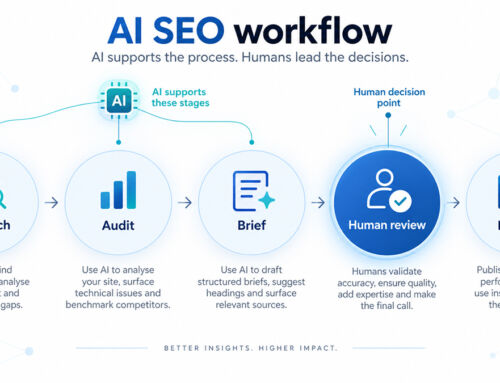
First, treat AI as a drafting tool, never a publishing tool. Let it get you to a first draft faster. Then a human reviews it, corrects it, fact checks it and adds the experience the machine cannot. Raw AI output should never go straight to your live site, and never on anything that touches health, money or safety.
Second, build for topical authority. Decide what your business wants to be known for, structure your site around those subjects, and make sure every page earns its place. AI helps you fill the structure. The structure itself is yours.
Third, keep a human accountable for every word. Not as a box ticking exercise. As the thing that actually protects you, because the responsibility for what appears under your name is yours whether a person or a machine wrote it.
The bottom line
You can generate content yourself. You can sort it, publish it and move fast. None of that is in doubt. What is in doubt is whether speed without judgement protects the asset you have spent years building.
Used well, AI is the most powerful drafting assistant your team has ever had. Used unsupervised, it is a liability that can quietly dismantle your search presence before you notice anything is wrong. The difference between the two is not the technology. It is the human standing behind it.
That is the part you cannot automate. And in our experience, it is the part that makes all the difference.
Frequently asked questions
Does Google penalise AI generated content?
Not for being AI generated. Google’s stated position is that the method does not matter, only whether the content is useful. What it does penalise is thin, low value content produced at scale to manipulate rankings, under its scaled content abuse policy. A great deal of that content happens to be AI made, which is why the two get confused.
Can you use AI for SEO content safely?
Yes. Use it as a drafting tool, not a publishing tool. Let it produce a first draft, then have a human review it, fact check it, add real experience and confirm it fits a clear structure. The danger is never the AI itself. It is publishing AI output unchecked and at volume.
Why do AI built websites get deindexed?
Usually because they pile up thin, near identical pages with no real value, which can breach Google’s scaled content abuse policy. A sprawl of unstructured pages also confuses Google’s crawler, makes pages compete with each other, and dilutes the signals that build authority. More pages is not more authority.
What is the difference between SEO, GEO and AEO?
SEO is optimising to rank in traditional search results. GEO, or Generative Engine Optimisation, is optimising to be the source generative AI builds its answer from. AEO, or Answer Engine Optimisation, is optimising to be the direct answer to a question. All three now reward clear structure, self contained answers and demonstrable trust.