What is AI ranking
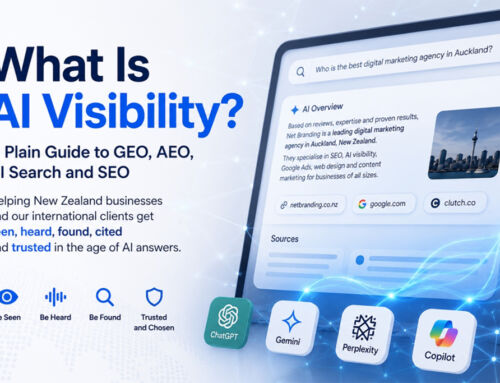
AI Ranking is when an AI search tool chooses your business as part of its answer.
Not just a blue link.
It is your brand, your pages, and your Google Business Profile getting pulled into AI Overviews and other AI answers.
You are mostly right.
- It is about exposure and being shown in AI Overviews and AI-style search results.
But the bigger point is this:-
- AI Ranking is about being used, not just listed.
What AI Ranking looks like in real life :-
- The AI mentions your business name in the answer
- It quotes or summarises your page, then links to it
- It shows your Google Business Profile as a recommended option
- It uses your FAQs to answer follow up questions
- It sends people to call, book, or request a quote
Net Branding way to explain it in one line. SEO looks at where your page ranks. AI Ranking looks at whether AI systems choose you as the source people trust and act on
Quick check for you …
When someone asks an AI tool, best option for your service in your area, does it say your name or someone else’s?
Table of content
AI ranking, what people mean when they say it
People use “AI ranking” as a shortcut. They usually mean one of two things.
You either want to appear as a cited source inside an AI answer, or you want your brand mentioned as a recommended option. Google AI Overviews and AI Mode still rely on web pages and links, but the layout changes. You can win visibility without being number one in blue links, but you still need strong pages that Google can index. Google says the same SEO basics still apply for AI features. That matters. It means no secret hack, just better execution.
If you sell services, AI ranking also includes local signals. A business name, address, and phone number that match everywhere can affect whether tools trust your details.
Ask yourself one blunt question.
If a customer asks an AI tool “who should I hire”, would it be able to describe you correctly, with proof, and point to the right page?
Where AI ranking shows up, AI Overviews, AI Mode, chat tools
AI ranking is not one screen. It is a mix of surfaces.
In Google, you can show up as:
• A link inside AI Overviews
• A link inside AI Mode responses
• A classic organic result below the AI panel
Google describes AI Overviews as a snapshot with links, and AI Mode as a deeper, more exploratory experience with follow up questions. Both can use query fan out, meaning Google runs related searches and then builds a response from what it finds. That pushes you toward topic depth, not single keyword pages.
Outside Google, people ask ChatGPT, Gemini, Perplexity, and Copilot for recommendations. Those tools often favour clear, quotable passages and sources with repeat mentions.
So your goal shifts slightly.
You still want to rank. You also want to be “easy to cite”.
If you sell products, AI panels can capture the early research phase. People might not click straight away. They may screenshot the answer and come back later. That is why brand recall matters.
Try this test.
Search your category plus “best” or “compare”. Note which brands show up in the AI panel. Then check what those brands have in common on their pages. You will usually spot depth, clear structure, and real proof.
AI ranking shows up in three main places.

Signals that influence AI visibility, content, brand, trust signals
Most AI visibility wins come from boring fundamentals done well.
Content signals
• Clear page purpose, one job per page
• Question led headings that match real searches
• Short answers near the top, then detail
Trust signals
• Real author names and bios
• Proof of work, case studies, before and after results
• Consistent business details, including address and phone
Technical signals
• Pages indexed and crawlable
• Fast, clean mobile experience
• Structured data that matches what the user sees
Google’s own guidance says there are no special extra requirements for AI Overviews and AI Mode beyond being eligible in Search. That tells you where to put your effort. Fix the basics, then make the content easier to extract and check.
One extra factor that trips people up is consistency.
If your phone number shows one way on your site and another way on listings, AI can repeat the wrong one. We have seen this with businesses that changed providers and left old numbers on directory pages. It sounds small, then it costs leads.
If you want a practical audit, keep it simple and time boxed.

A quick audit you can run in one week
Day 1 to 2: map your “AI questions”
• List 30 questions customers ask on sales calls
• Add “best”, “vs”, “cost”, “near me”, “is it worth it”
• Run those 30 questions in Google and record which ones trigger AI Overviews or AI Mode
Day 3: check whether Google can index your key pages
• Search site:yourdomain.com plus your service
• Confirm the right page shows up, not a thin blog post
• Take screenshots of results for each market you care about, even if it is just US, UK, NZ to start
Day 4: rewrite one high value page for extractable answers
• Put a 50 to 80 word answer at the top
• Add a short comparison table
• Add an FAQ block with direct answers
Day 5: tidy your brand footprint
• Match your name, address, and phone across your site, profiles, and listings
• Add the same contact details on every key service page
• Log the exact queries that triggered AI panels this week, plus which sources Google cited
You can repeat this weekly. It is dull. It works.
Day 6 to 7: measure what moved
• Watch impressions and clicks in Search Console for those pages
• Track brand searches, even if traffic stays flat
• Manually check a handful of prompts each week and save screenshots
• Check your Google Business Profile shows the right categories, services, and phone number
• Screenshot the map pack for your top local query
You are looking for patterns, not perfection.
A short report.
• 3 screenshots per market, AI panel, organic results, maps
• A short table of triggers, citations, and next actions
When it makes sense to use an agency to rank on AI
An agency helps when you need speed, consistency, and honest measurement.
You might want support if:
• You manage multiple countries or cities
• You need structured content at scale
• You have a strong product, but thin proof online
A good AI ranking agency will not sell magic. They will do the groundwork.
• Topic and question research based on real search demand
• Content that reads well and also extracts cleanly
• Digital PR and brand mentions that build recognition
• Tracking, so you can see when you start getting cited
At Net Branding Limited, we call this Be Seen, Be Heard, Be Found.
If your team feels stuck, you can hand off the heavy lifting, then keep ownership of the strategy.
A simple way to vet an agency is to ask for a sample.
Ask them to take one page and turn it into an “AI ready” page.
• A direct answer block
• A clean set of H2 headings in question format
• A short FAQ
• A table or checklist that a model can quote
If they cannot show that, you will struggle later.
About Cathy Mellett
Cathy Mellett is the director of Net Branding Limited. She has worked in digital marketing for decades and also leads community focused projects through I’m Enough. If you want help with AI search visibility and SEO that stays practical, she leans into clear systems, tidy site structure, and proof, not hype
Net Branding Limited
- 165 Orakei Road, Remuera, Auckland 1050, New Zealand
- Phone: +64 9 523 0478
- Be Seen, Be Heard, Be Found Online